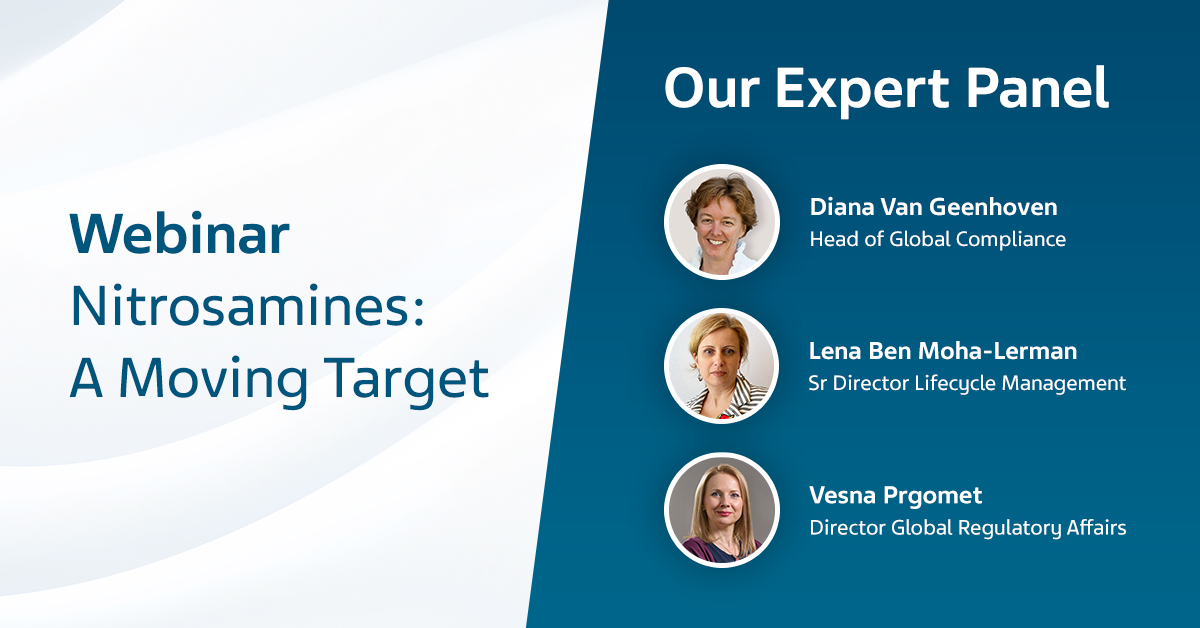
Our recent webinar, Nitrosamines: A Moving Target was a deep-dive into the issue of Nitrosamines impurities and how you can stay on top of the various evaluation requirements to remain compliant.

During the webinar, Diana Van Geenhoven, our head of global compliance, Lena Ben Moha-Lerman, Senior Director of Lifecycle Management within Teva api’s R&D team and Vesna Prgomet, our Director Global Regulatory Affairs, spoke to our listeners about the critical three-step approach when it comes to Nitrosamines, Risk Assessment, Confirmatory Testing and Changes for Marketing Authorization.

If you missed the live event, here are your highlights!

What changes should I look out for when it comes to Nitrosamines?

Over the past three years, there have been a lot of changes in Nitrosamines regulations. While the evaluation requirements started out with a focus on NDMA, now the guidelines contain many other Nitrosamines, too. It started out with Valsartan as the main product to be included, and now all chemical synthesized medicinal products as well as products produced by fermentation and biological syntheses have to be assessed. Acceptable Intake levels also have been changed during the last years.

Other extensions to the regulations include regarding the root causes for the presence of Nitrsosamines for example checking for cross-contamination as part of your evaluation.

In some cases, the evaluation criteria actually has become less stringent. For example, back in 2019 the FDA said that Nitrosamines in Sartans should be undetectable. However, in 2020 – the FDA updated this with new guidance and relaxed this requirement. Timelines have also been changed, especially in response to the COVID-19 pandemic. For example, the EMA relaxed the deadline for the first step in the Nitrosamines assessment from March 2020 to September 2020 and then again to March 2021.

Lastly, several publications have been issued over the past three years which explain the different ways that you can test for Nitrosamines, depending on the product you’re testing.

Risk mapping for Nitrosamines

There are three steps for Nitrosamines’ risk mapping. The first is the theoretical risk assessment. If a risk is found, you then move to confirmatory testing. If indeed Nitrosamines have been found at a higher amount than the limit, you will need to optimize or change the process before submitting this change to the relevant regulatory agencies. Let’s look at each stage in more detail.

Risk assessment

Theoretical assessment should address all root causes as defined by relevant guidelines and can be grouped in three potential sources for risk with Nitrosamines. These are the chemical process, cross-contamination and contaminated raw materials/solvents.

Nitrosamines formation is attributed to a reaction between the secondary amine and nitrite ion, therefore Nitrosamines can be formed in chemical process only if both of these are present. If one of those components is missing there will be no risk of Nitrosamines formation.

It is important to emphasize that secondary amine doesn’t have to be present as it is, it could also be sourced from primary/tertiary/quaternary amine that is used in the process. Secondary amines can be also process intermediates of the API itself. Similarly, nitrite can be used itself in the process or it could come from other sources such as hydroxylamine or nitric acid. Process water should also be assessed for the presence of nitrite ions, as they can react with amines used in the process.

Remember: Secondary amine and nitrite ion don’t have to be used in the same synthetic step. Traces of reagents might be carried over to the later steps.

Another aspect of potential risk could be contaminated starting materials and solvents, such as recycled solvents or materials that we source from a third-party. To address this risk at Teva api, we send dedicated questionnaires to all our vendors and based on their answers we conclude whether or not there is a potential risk. In case we conclude that there is a risk – API produced from this vendor is subjected to confirmatory analysis.

Confirmatory testing

Confirmatory testing is required for commercial products as well as for any new products to be launched. Different regulators have varying amounts of Nitrosamines that are considered to be acceptable. For example, under the EMA guidelines, less than 10% of the Acceptable Intake is considered to be low enough risk, while the FDA doesn’t spell out this ratio. The EMA also says that 10% of commercial batches should be tested, while the FDA does not have guidance on the number of batches to be tested.

At Teva api, we develop and validate highly sensitive analytical methods for confirmatory testing, utilizing machines such as GC-MS 3Q or LC-MS 3Q.

Our methods are developed to monitor specific Nitrosamines which according to the process in question could potentially be present in each API in line with all the current regulations and best-practices.

Submitting a change

Once the risk assessment activities have been completed, you’ll have a clear idea of what changes need to be implemented. For example, you may need to change the manufacturing process by adding an extra purification stage, adjusting a process, or adding a new step. You may also need to make changes to the premises or the equipment you use.

You’ll need to validate the specification and method you’ve developed to fix the problem, and ensure that you’ve controlled the change going forward, for example changing a supplier or codifying the new manufacturing process.

Now, it’s time to communicate the changes to the customers, MAH, authorities and to regulatory boards. At Teva api, as an API manufacturer and a CEP holder – we submit these change requests to EDQM, noting whether this is a minor or a major change in process. For example, the inclusion of mutagenic impurity in API specification is a minor revision, and so is any update in the impurity section.

Remember: In relevant case when nitrosoamines risk assessment needs to be added, even if the risk assessment only concludes that there is no risk being added – EDQM still requires this to be submitted as a minor revision (not as notification).

Facts and dates for your diary

  • All relevant CEPs should be revised in order to control Nitrosamines by 26th September 2022.
  • For US market, DMF amendment include relevant updates should be prepared and submitted to FDA in collaboration with MAH. FDA allows proposed process to be submitted with estimate for removal of the original process. The different synthetic processes should be identified by separate codes.
  • Deadline for MAHs to submit changes to FDA is Oct 1st 2023.
  • If the original process cannot be discontinued within a reasonable timeframe, the new or revised process should be submitted in a separate DMF.

At Teva api, we work together with our vendors, customers and partners to ensure that we carry out a thorough risk assessment and testing process, ensuring that we have plenty of time to communicate and submit changes before the dates provided.

If you’d like any more information on how we work to control Nitrosamines in our API manufacturing, reach out here, or watch the complete webinar below.

“It’s like doing magic every single day!” Marina Yarovoy is Downstream Process Manager in Teva api’s R&D team, and is based in Israel. She describes her passion for all things chemistry and why the generics industry is so inspiring.

Teva api was my first job in chemistry! I started in the team shortly after graduating from university with a BSc in chemistry. That was 14 years ago. After being a researcher for 9 years, I then got promoted to team leader. It was a great opportunity for me! I love the dual role of managing the development of a product while guiding people. I learn a lot through teaching others.

While working, I embarked on and completed my master’s degree in organic chemistry. It was a unique opportunity and I am thankful to all the people who supported me. Even my thesis revolved around one of Teva’s projects. It was like a dream come true for me!

I am now building a new department which is a huge learning experience. I was recently promoted to downstream process manager. Taking my productivity to a new level, I will now oversee the whole chain and give special attention to the purification, ultra-filtration and freeze-drying processes. I’m excited to lead my teams, and my ultimate vision is implementing agile workflows supported by cutting-edge technologies.

I really like baking and cooking, which is the perfect example of chemistry. I believe that chemistry is a way to understand the world around us. Chemistry is something I’ve been passionate about from a young age. In fact, my grandmother was an analytical chemist back in the USSR days, so maybe it’s in the genes!

There’s inspiration in generics. Hundreds of years ago, if you had a headache, there was no medication to take. The pharma industry gives us the opportunity to address and overcome health issues. This is especially true in the generics industry. For example, a cousin of mine had a medical problem and received a prescription for a costly medication. I explained to him that he could get a generic version for one-tenth of the price. Generics make medicine accessible, opening new opportunities to previously closed markets, and sometimes these drugs can even result in life-changing situations. It’s extremely motivating.

In university chemistry is an exact science, but in reality it’s also an experimental science. It can surprise you but it can also disappoint you. Chemical reactions don’t always react as expected!  It can be really challenging. You need the patience to understand your molecules and understand their unique needs – like a relationship!

I believe that there is no problem that isn’t solvable. There is always a solution for any problem. It’s just depends on external factors like time, money, and resources that you need to invest in, to make it work.

The people I work with share the same DNA. They’re very dedicated, they love their job, and enjoy the challenges. I feel that they are with me on this mission. I truly believe that a good team is the key for success.

It’s the human connection between the team that helps us succeed. As a manager, it is crucial to understand the people you work with and to know what drives them. Every single day, I make the effort to recognize each team member and their efforts. Sometimes it’s not about being successful in a specific mission, but the steps and efforts that are made to get there.

I think I’ll be at Teva for many years to come! I like the people around me, I keep growing here, and I feel that my efforts are genuinely recognized. It’s a great place to do the work I love and I feel proud at the end of each day.

“Every day I get up and go to work and see a new problem, an opportunity to learn something new – and this is what I really appreciate.” Lena Ben Moha-Lerman is Senior. Dir. Lifecycle Management at Teva api R&D, supervising R&D activities for post-submission products with 6 R&D teams from all around the world. She talks to us about her passion for becoming a Scientist, her inspiration, and what she loves about working in Generics.

It felt really natural for me to go to the biggest generics company in Israel, one of the market leaders the world over.

I’ve been with Teva api R&D since 2007, right after finishing my PhD in Medicinal Chemistry. I started out in API R&D as a Senior Scientist, and quickly got promoted to Team Leader. After a few years I became the Head of the Chemical R&D department, and more recently in 2018, I’ve taken on a more global function, supervising products from submission to commercialization across 6 teams worldwide.

I credit it all to my chemistry teacher!

I had a perfect chemistry teacher, she was incredibly inspiring. Looking back, this was the only reason why I decided to go forward in this field. I actually didn’t even submit my application to any other track! I don’t regret it for a minute. My first degree was in medicinal chemistry, and then I took a direct path to PhD. Altogether, I was in university for 9 years.

It’s an amazing feeling to know that every day we’re working on the development of many life-saving APIs.

I’m so proud of my API R&D teams, we’re doing life-saving work. I look at the Teva api portfolio and I know that a lot of very important products were developed in my teams, and that’s incredible to know.
Whoever is a scientist by nature will never get too far from it. As with any position, as you become more senior, you have less opportunity to dive into the details, in my case, in API Research and Development, that’s the science. But every time there is a complex issue to solve, I’m reaching back in, and directing teams which way to go, transferring know-how or skills from one team to another, or supporting with scientific guidance and troubleshooting. I love that.

I look at APIs and Generics like a puzzle that needs to be solved.

When you’re working in a generics company, there are so many pieces to put into place. You know what the final picture should look like, but you have to combine the puzzle pieces and overcome issues like IP restrictions and innovator hurdles, and competition from other companies in Pharma. These are the challenges that are blocking our way to breaking down the code and generating the molecule. We really have to use out-of-the-box thinking and be creative.

Not many people can say that they are constantly learning, so that’s a really unique benefit of my job.

I learn something new every single day. Of course, there are challenges, being exposed to global teams and cultures, getting to know new people all the time, and how to work across teams that include customer success, sales, marketing, regulatory affairs, and more. But every day I get up and go to work I know that I will learn something new, something that I didn’t know yesterday – and this is what I really appreciate. This opportunity to learn is incredibly valuable.

You will face a lot of failures before you find success.

I find that in my job, you have to be optimistic. In science generally, failure is an embedded part of the process. So you have to believe in yourself, and in your innovation and your capability to solve a problem. That also means not taking to heart the failures, because it’s part of the process, and the day after you will rise up again! I love the feeling of going into the Pharmacy and seeing on the shelf a medicine with Teva’s logo and knowing that the API came from my team. It’s where I see the fruits of my labor, and it’s an amazing moment for me, every time.

I’m looking forward to returning to travel!

I have a few hobbies, such as playing piano which I love doing in my spare time. I also like to travel to see new places and to meet people from different cultures. As part of my job I used to travel frequently, and as a family we always took a vacation once a year to a new place. I do hope that everything will stabilize soon, and that we’ll all be able to travel again before too long.

Zvonimir Lackovic tells us what it’s like working in API manufacturing, as a chemist in Production, and explains how it’s just like playing a challenging round of chess! Read the full blog, here.

Teva api was my first job out of college. My journey to Pharma API manufacturing started back in 2012, when I started out at Teva api as a chemist in the R&D lab. Within the first few months I saw my future in this industry, I could see that there were great opportunities here, and the company recognized my knowledge and my work ethic.

What is the Teva api R&D lab like?
We have a steady flow of API compounds, and pride ourselves on providing customers with early launch opportunities, innovating where we can create value. That’s actually one of our company values. And so we are constantly innovating in order to implement new technologies and support highly-complex products.

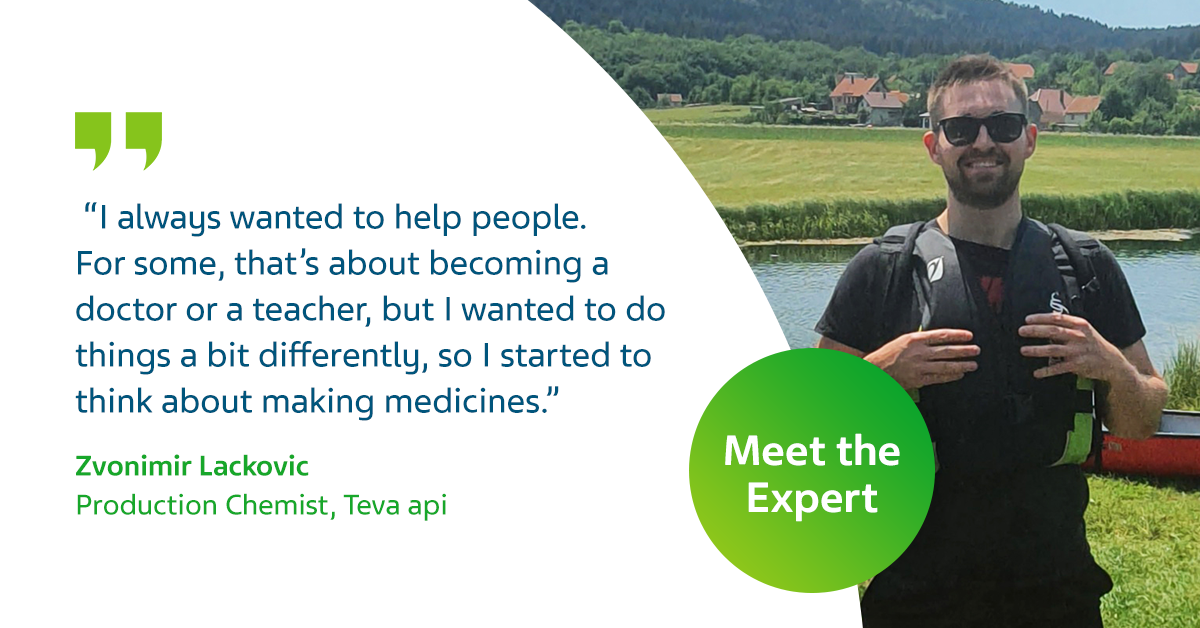
I knew from preschool I wanted to work in chemistry! I had a great teacher when I was very young, she was a teacher and also a chemist. I saw myself working in a lab or in production, and I’ve now done both! I always wanted to help people. For some, that’s about becoming a doctor or a teacher, but I wanted to do things a bit differently, so I started to think about making medicines.

Every day is different at Teva api. I now work in production, where we are developing and producing Active Pharmaceutical Ingredients. With such a large portfolio of products, you can be sure that the next day or the next week, you’ll be working on another product! The work is very dynamic, and I need to be flexible, open-minded, and ready for anything.

We know how important our work is. I think the biggest challenge working in Pharmaceuticals is the time. We are making these products for people who are sick, they don’t have time to wait. We know who is waiting for us to get our work done, and this is special and important, but it’s also a great challenge.

The industry has changed over the past decade! I worked in the lab in R&D for two years, and then in 2014 I moved to production. More recently, I moved to a new plant, it’s more modern and has a lot of new technologies, too. It’s great to be at Teva, where we’re leading the industry, and you can see that across the whole company. For me, it’s shown by Teva giving us cutting-edge tools to make our jobs easier, and which allow us to be more accurate and give greater precision. Innovation has a measurable impact on the products we create, our APIs have high purity, we can get products out faster, and more.

My job is like a game of chess. You always have to be thinking to work in this field. Like in chess, you want to be a couple of moves ahead so that you can do the best job possible. You never want to be stepping into the unknown. I’m a perfectionist, so although I’m not a control freak – I do like knowing what to expect!
My knowledge and experience keeps me cool-headed. It’s important to keep a cool head, and to be creative about problem solving. I like to think about a situation, and consider what I can do to help others and to get us past a challenge. It’s also important to work as a team. You might have special abilities, but you can’t do anything solo. Being a team player is so important if you want to achieve.

Working in a dynamic area keeps me on my toes. I love working with other departments such as API R&D or Quality Assurance, and we have such a broad portfolio that it’s never boring! If you have a job where you do the same thing every day, you can get lazy, your mind can become lazy. That’s what I think of as a routine job. My job is the opposite of that! It keeps you in shape. We always have new products and transfers to think about, and with new products every two weeks, I’m always learning new procedures and science, and that keeps me sharp.

I’m an outdoorsy person. Making time for yourself is really important. In my spare time, I’m quite a sporty guy. I like to train, I’ve spent a lot of time weight-lifting, hiking, and I enjoy kayaking with friends, too. I love to spend time with my family and friends.

Our recent webinar was about all aspects of cocrystals! We heard from Anantha Rajmohan, Head of Physical R&D India, Diana Skalec Samec, Senior Group Leader for Physical R&D, and Maytal Piran, Director of Global Physical R&D. They spoke in-depth about how to choose the right target for your API, the advantages of using cocrystals, and various regulatory considerations to think about. We also heard about Ibrutinib – an example of cocrystals in action! If you missed the live event – consider this your catch up.

Drug Discovery and Development

Drug discovery and development can take 10-15 years before final approvals, starting with basic research all the way through to an approved drug. Millions of dollars will go into the process, including a large proportion on clinical trials. After selecting the active molecule, 70% of drugs approved by the FDA are solid, so selecting the right solid candidate is very important.

Once the active molecule is identify, the solid-state analysis such as salt and polymorphous search start.

Choosing the right target is no easy task! To start with, the solid form should be stable and reproducible at large scale, and commercially viable, too. The right solid candidate should be stable in stress conditions such as temperature and humidity, which gives good opportunities to the formulator.

Understanding Cocrystals

Cocrystals can be reproducible and can enhance the process of APIs, adding value to the business. In cocrystals, both components are solid at room temperature. This is differentiated from salt by the bonding between the components. In salt there is an ionic charge separation while in cocrystals it’s a hydrogen bonding, a much weaker bond. Depending on the API, cocrystals can be split into four types – cocrystal, salt cocrystal, cocrystal solvate or sulphate, and salt cocrystal solvate. You’ll need a strong characterizing team to differentiate between the types.

In 2018, the FDA defined cocrystals as crystalline materials composed of two or more different molecules, typically an API and coformer, in the same crystal lattice. These can be tailored to enhance the bioavailability and stability of drug products. Interest in pharmaceutical cocrystals is growing, with research and interest increasing steadily over the past decade. Already available in the market are drugs including cocrystals.

You can see the process for the characterization of cocrystals, below.

Regulatory Considerations

This is one of the most important thing to think about in Pharma. For the FDA, cocrystals are classified as a special case of solvates and hydrates and pharmaceutical cocrystals are placed in the regulatory classification similar to that of a polymorph of the API. The chart below can be a helpful resource to explain the main differences between FDA regulation and EMA regulation.

Your regulatory approach for cocrystals should ensure three things. First, that the API and the coformer exist in neutral states, and any interaction between them should be non-ionic and non-covalent. Second, that the value of the ΔpKa should be less than 1, that is ΔpKa [pKa (base) – pKa (acid)] <1. Last, the API and the coformer should be disassociated before reaching the site of pharmacological activity. These three steps are foundational to put you in a good place to gain regulatory feedback.

Deep Dive on Ibrutinib – an Example of Cocrystal Formulation in Action

Ibrutinib was developed by Pharmacyclics and Johnson and Johnson, and was approved by the FDA in November 2013 for the treatment of B cell cancer treatment. It is expected to be third in the best-selling cancer drugs of 2022*.

At Teva api we started developing Ibrutinib api for generic submission by undertaking a literature search, a polymorphic search, and a cocrystal search. We made an evaluation on long-term stability and during the development process, on solubility and reproducibility as well as handling conditions. We found a few crystalline and amorphous targets and started looking into each.

At this stage, we found that our forms weren’t suitable enough for formulation. When you’re evaluating your target, you should look out for some parameters such as limited physical and chemical stability, sensitivity to production process, solubility, handling, and limited crystallization options to control morphology.

We then initiated a cocrystal research. During the search of coformers, we found several options, going back to the lab in order to prepare them. After characterization we found three options for a cocrystal in terms of a coformer, Benzoic, Succinic and Fumaric acids. We tried to prepare these on a high scale, and finally Ibrutinib Hemi Fumaric Cocrystal was found to be the most appropriate target..

Teva api’s Ibrutinib has a robust process, long term chemical and physical stability. During the time that we were working on Ibrutinib, we followed the FDA guidelines to apply for regulatory support. Following all regulatory requirements, we submitted our DMF in the US. We got FDA tentative approval, and the FDA has even used our DMF for Ibrutinib as an example of cocrystal characterization!

Key for Success with Cocrystals

  • Deep chemical and analytical understanding: This was the most important element for our own success. Really know the product.
  • Agility in development: Be able to test candidates in parallel and to change quickly from one to another where needed.
  • Collaborate meaningfully: Communication across supporting units including patent , quality control, regulatory affairs and marketing teams.
  • Customer-focus: Constant communication, sharing knowledge and updates with your customer as necessary.
  • Data sharing: Think about what kind of knowledge you can provide to assist the formulator, or if you’re asked to provide additional information.

To catch up on the full webinar, including learning about the challenges of choosing a conformer, the different strategies and advantages of cocrystal formation, and the benefits of using cocrystals over other alternatives, plus the informative Q&A session, watch the whole on-demand webinar below.

The information contained herein is the confidential and proprietary information of TEVA PHARMACEUTICAL INDUSTRIES LTD. and its affiliates. The information contained herein is provided as courtesy only, and should not be considered in any way as legal, regulatory or otherwise professional advice. You should seek appropriate professional counsel for your own situation and requirements. No representations or guarantees whatsoever are intended to be given by TEVA PHARMACEUTICAL INDUSTRIES LTD. Teva makes no warranty as to the completeness or accuracy of the information provided herein. Furthermore, no information in this presentation, including any reference to any product or service, constitutes an offer for sale, or should be construed as representing an offer for sale. Specifically, no part of this presentation should be construed as a promotion or advertisement for any product, or for the use of any product, that infringes valid patents and/or is not authorized by the laws and regulations of your country of residence.

“There’s no such thing as a leader without a team, and a team can’t function without a leader. This is an important mantra for me to live and work by.”

Veronika Vital is Teva api Head of Project Engineering, leading a group of 8 on many diverse API investment projects. She speaks to us about her background in Pharma, her guide to being a great leader and encouraging greatness from her teams, and how to think strategically and get a wider view of any challenge.

I joined Teva api Development Manufacturing & Supply Operations last year as Head of Project Engineering. I work on the API path, and I lead a group of 8 project engineers and tech supervisors. I love the diversity of my role, where I work on short and long-term projects, guaranteeing API quality execution, implementation of all the relevant guidelines, and all within the right budget and timeline.


I’ve been working in Pharma for 15 years! I started out with a mechanical engineering degree, and I immediately started my working life in Pharma. I’ve got a wide range of experience, from APIs, to biotechnology, vaccine production, containment systems, solid form processing, and more. I’ve seen the industry from several angles, and this was a really important goal for me, so that I could see all the important aspects first-hand and recognize how it all works as a unit. I use that same technique now in my role at Teva api Development Manufacturing & Supply Operations, working across many teams, seeing how they all fit together. This allows me to think more strategically. When you can see and understand how all the parts work, you can think outside of the box.

I would never want to work in an area I’m not interested in! The role depends on my professional and communication skills, and I love that. Every day I’m in contact with a lot of different teams, as the projects I lead are so comprehensive. We’re involved in projects all the way from the design stages to execution, including commissioning and validation, so there a lot of people in the mix! Internally, I’m dealing with Quality Assurance and Quality Control teams, the maintenance, electrical and automation teams, API site production experts, EHS, MS&T, Supply Chain, and more. Externally, there’s a lot of collaboration with other stakeholders too. It’s all about collaboration. This helps to challenge me and allows me to continually improve myself.

The market is really strong, which means we need to keep pace. My biggest challenge is probably keep step with new technologies and react quickly to the changes while focusing on the quality of the product and the impact on the people involved. It’s a big responsibility to keep to the project timelines, and we focus on decreasing costs while increasing efficiency in our projects. We need to be very quick in our reaction times, all while dealing with a lot of projects in parallel, and with just eight of us for the whole site! Without working as a team, this can’t happen.

My team is a group of advanced thinkers with advanced vision. It’s always challenging to work as the leader of a team, but this is one of the things I love the most about my job. I’m very dedicated to supporting my team members in their own professional development. I focus on each person from their own point of view, and I try to build trust with them, because without trust you don’t have anything. I look for what motivates each person, and what would make them satisfied, and support them in getting their and reaching these goals. I make sure that we have plenty of regular one to ones, not only related to open projects, but also for discussing personal skills such as change or time management, or communication.

To be a good leader means to be confident in your team. This trust goes both ways! Of course, as soon as you have team members who are reaching their own goals and who feel satisfied in their job, they’re going to give you 100% in return, and they will be much better at their job. They will be more committed to the team, to the role, to Teva api as a whole. There’s no such thing as a leader without a team, and a team can’t function without a leader. This is an important mantra for me to live and work by.

It’s essential to be mindful of mental health when keeping up with intense schedule. With a complex day job, I definitely need to make time to decompress and relax. I love high intensity training, jogging, and sports, but I also equally love curling up with a good Hungarian novel. Sometimes I read professional development books too, such as Everyone Communicates; Few Connect, by John C Maxwell. I also love going out with family and friends, and ensuring I’ve carved out time to not think about work at all.

For streamlining customer processes, and maximizing productivity for end-users, a customer portal is a must-have tool. Your ultimate goal is getting life-saving and life-changing medicines to your patients with more efficiency and speed. When it comes to making submissions, tracking orders, and ultimately – helping your patients, that’s exactly what a customer portal can help you to achieve.

Here are 5 reasons why utilizing a customer portal will revolutionize the way you do business in generic drug manufacturing, and when working with an active pharmaceutical ingredient supplier.

An Always-On Level of Support

One of the best things about an online portal is that it’s available 24 hours a day, 7 days a week. That means that even if you’re in a different time zone from your vendor, or your customer experience representative or account manager is taking a vacation day or feeling under the weather, you have the answers that you need, when you need them. When the platform is well-built, it should be intuitive enough that you can navigate to the information that you’re looking for, such as product details, documentation, service requests made by other members of the team, order tracking and more.

This is also great for troubleshooting. According to the Harvard Business Review, 81% of users start by trying to figure out a problem for themselves, before they turn to a customer representative. Self-serve is therefore an essential offering. A robust customer portal can give you access to Frequently Asked Questions, a searchable knowledgebase, and an archive of the communication you’ve had up until this point, all in a single view. If you still can’t find what you need, the portal should also be the place that you reach out to get added support, with the ability to approach your account team with a query, and get a quick and accurate response.

Documentation at Your Fingertips

In generic drug manufacturing, the need for documentation is a daily companion! A self-service library is therefore a great addition to a customer portal, and one you should ask your vendor about. Some examples of documentation that you can find in the Teva api Connect library are:

  • GMP certificates: GMP stands for Good Manufacturing Practice, and these are provided after various regulators have inspected and certified that the pharmaceuticals fit their regulations for safe use. Certification varies between countries and regulators, so you may have multiple certificates for each product. The same applies for Manufacturing Licenses and Written Confirmation.
  • Certificates of Analysis: These are known as CoA, and are an essential part of working with APIs. The certificate will likely include details such as the batch number, release dates, product specifications, and a list of the tests performed and their results. You may also need representative CoAs for different markets, based on your requirements.
  • Product Information: Any other general or often-requested information on the API such as Allergen statements, Safety Data Sheets, GMO information, Product Stability information, TSE/BSE, and more.
  • Nitrosamines Statements: These are an example of essential information that may be needed due to new regulations, showing that impurities have been controlled according to law. This and other risk assessment statements help you to plan effectively when working with highly-regulated materials and products.

In our own customer portal at Teva api, there are more than 6,000 documents available from the self-serve library, allowing our customers to get what they need, when they need it.

Enhanced Collaboration Across Teams

Another huge benefit of a customer portal is the ability to see immediately what communication has been started about any particular product or matter. With user accounts organized and personalized under a common customer account, you can simply search through previous correspondence or via a specific member of your team, and follow a chain of communication through to its conclusion or escalation. According to McKinsey Research, organizations with more connected employees see productivity gains of as much as 25%.

This correspondence should be accessible at all times, even if a colleague is out of the office, or after a particular member of staff has left the company, and provide a complete view of any open, on-going or closed communications. It’s also helpful for ensuring that staff members can collaborate easily, and so that even if a particular employee is unavailable (either internally or on the side of the vendor) business continuity remains at a high. In a remote-working reality, these benefits are more important than ever.

Stay on Top of Orders and Queries

A customer portal will also be the place that you can track and follow any service request, open orders, or regulatory announcements. Feature-rich customer portals will include notifications, so that you never miss an update. No more scheduling face-to-face syncs to get the answers that you need – your account manager can reach out directly and you can check for new notifications at leisure.

When you’re waiting for an order, having a centralized place where you can see real-time information is also a real game-changer. Imagine the following customer journey, all from a single digital dashboard.

You start by browsing products to see what APIs suit your current needs, checking for the documentation that you’ll require ahead of time, or asking for samples. Next, you send in your purchase order through the secure messaging system. Once accepted, you can track your shipments, see where your orders are and follow the timeline, and even download all your shipping documents from the same user interface. Any problems? Just continue the same conversation with your account manager, or delegate to a colleague.

Keep Up to Date with the Product Pipeline

In Pharma, your attention needs to be firmly future-focused. Not only do you have your eye on open projects and the latest innovation, but you also need to have a full understanding of what’s around the corner. A customer portal should be able to show you a clear view of which products are in the pipeline, allow you to download relevant information as necessary, and see the availability of regulatory files for different regions.

In this way, a customer portal becomes more than just a centralized place for all of your own individual information. It becomes a powerful dashboard that can maximize your productivity, speed up support, enhance collaboration, and provide answers to questions exactly when you need them.

Teva api’s customer portal is called Teva api Connect – and it’s easy to log in securely and get started! Get in touch to sign up, or login now if you are already registered, and start making Teva api Connect part of your daily working life!

At Teva api, we always remember how essential our work is to the wider community, and this was never more important than this past year, when the COVID-19 pandemic hit. As Teva’s Chairman, Dr Sol J Barer said, “At Teva, it reminded us of our responsibility to patients, our employees, communities and the planet. It required us to adapt and conduct business as usual in the most unusual of times. It strengthened our resolve to elevate our words and actions in the face of social and racial injustice. And it reinforced climate change as a pressing concern that is not just environmental, but directly related to health.”

That’s why we are so happy to announce the results of the 2020 ESG report. This takes into account our environmental, social and corporate governance impact, and as a result, has put us in the top 10% of Pharma companies in terms of our Sustainalytics, the method that is used to measure and rate the relevant organizations.

Corporate Governance in Response to the Pandemic

In 2020, we continued to embed inclusion and diversity across the organization, including seeking high-quality, diverse talent at all levels of the business. 82% of employees agree that Teva promotes inclusion and diversity in its culture, which is a great thing to see. We also saw our best employee safety performance to date, which showed a 15% drop in recordable injuries.

In a global business, there is no ‘one way’ to be impacted by something like COVID-19. We are proud to say that we had zero COVID-19-related job losses, and as the pandemic evolves, we continue to put a lot of efforts into encouraging our staff to do what they need for their wellbeing and their families, including working flexibly, and taking paid vacation days when in need.

The Social Impact

The pandemic put medical care and access to pharmaceuticals under the spotlight, and the ESG report has certainly highlighted our ability to act under pressure. As Liran Nagar, our Teva api Global Supply Chain Hub leader, said, “There was no precedent for this. In my 16 years in supply chain, I’ve never encountered an emergency on such a grand, global scale.” Incredibly, the supply chain has remained “largely uninterrupted across all markets”, and we have made huge strides in speeding up and increasing production to meet the unprecedented need. We kept our labs open, our manufacturing sites running, and continued to serve almost 200 million people each day.,

Teva api has also taken an important role in identifying active ingredients related to COVID-19 treatments that can be of use to patients who are in intensive care units. Examples include inhalers to treat longer-term respiratory symptoms of COVID-19, and muscle relaxants that make it easier and safer to intubate patients. As one of the largest fully-integrated manufacturing and delivery networks in Pharma, we were integral in building what the ESG report calls “resilient supply chains.” We doubled the number of medicines we donated to patients in need in comparison to 2019, providing more than half a million dollars’ worth of critical supplies.

The Environment Belongs to Us All

Of course, despite a focused approach to handling the evolving pandemic, the environment needs our attention more than ever. Our environmental sustainability is a huge part of working towards a better, safer, cleaner world. Our goals are aggressive, looking to reduce Scope 1 and Scope 2 greenhouse gas emissions by 33% by 2030, in comparison to 2017. This year, we have reached 25% – an exciting milestone. We’ve also reduced total energy consumption by 6%, and water withdrawals by 13%, in the areas that need it the most.

As President and CEO of Teva, Kåre Schultz commented in the introduction to the 2020 Teva ESG report,
“While our approach is now more formalized, the tenets of ESG—operating responsibly and sustainably and caring for people and communities—have been ingrained in our company since our founding. As we celebrate 120 years of improving the lives of patients, we remain dedicated to advancing the health of our patients, our planet and our business.”

Discover the full report.


Generic drugs contain an active pharmaceutical ingredient (API) that is similar to the originator product, but might have different and improved characteristics. Extensive development activities are needed in order to define the right chemical process and physical properties.

A different scientific approach contains a long list of challenges, and regulatory and IP rules should be taken into account.

The physical properties of the option you choose may have a major impact on solubility, stability and performance of the drug product. It will also have an influence on your production cost, regulatory procedures and time to market.

In short, the understanding of API characteristics and its behavior, including selected development approach, is necessary when deciding on the best option.

Here is a brief outline of the four options:

New polymorph

Polymorphism is a frequent characteristic of active pharmaceutical ingredients (APIs), and it refers to the ability of substances to crystallize into more than one crystalline forms.

Polymorphic forms of a drug substance can have different chemical and physical properties, including melting point, chemical reactivity, apparent solubility, dissolution rate, optical and mechanical properties, vapor pressure and density.

These properties can have a direct effect on the ability to process and/or manufacture the drug substance and the drug product, as well as on drug product stability, dissolution and bioavailability. Thus, polymorphism can affect the quality, safety, and efficacy of the drug product.

From the thermodynamic aspect, the common approach is to select the most stable crystal form for the formulation. However, the thermodynamic metastable crystal with better solubility and bioavailability could also be adopted for pharmaceutical preparation. New polymorphic forms may also exhibit different physical and mechanic properties, including particle size, density, hardness, outflow and compactness.

Generic products may comprise solid substances that have differentiated and improved characteristics over the existing knowledge in the literature. These solid substances can potentially be the subject of patent applications.

New polymorph Afatinib.

Amorphous

The second option is to create an amorphous API.

There are multiple advantages associated with amorphous APIs. They usually have higher solubility than alternative crystalline forms and, in some cases, amorphous APIs may be an alternative to crystalline material that is patent protected.

Having said that, working with amorphous material can also be challenging. You might need to overcome its tendency to recrystallize, absorb significant amounts of humidity, or create side reactions that lead to chemical impurities.

A lack of a crystallization process could also lead to a final API that is not pure enough for use. In some cases, these problems may be solved by having a good control of impurities during the process. Therefore, a robust process is needed, as well as a good R&D team to define it.

Co-crystals

Co-crystals are single-phase crystallines that contain two or more solids. One of the compounds is an API, and the other is usually an excipient. Generally, evidence to demonstrate that both the API and co-formers are present in the unit cell should be provided.

Choosing the right conformer, and finding the right conditions to create a stable co-crystal, is challenging. An efficient research plan and a dedicated R&D team are needed to find the right match.

As of  FDA guidelines1, a pharmaceutical co-crystal has a regulatory classification similar to that of a polymorph of the API.  Specifically, it is not regarded as a new API. From a regulatory perspective, drug products that are designed to contain a new co-crystal are considered analogous of a new polymorph of the API.

According to the FDA’s guideline 1, for the classification of co-crystals, If both API and co-former have ionizable functional groups: a co-crystal is required to have a pKa difference between co-formers that is less than 1, thus indicating a non-ionic species and minimal proton sharing. The aim is to distinguish between a salt and a co-crystal. Additionally, substantial dissociation of the API from its co-crystal form should occur before reaching the site of pharmacological activity.

A co-crystal that is composed of two or more APIs, with or without additional inactive co-formers,  will be treated as a fixed-dose combination product and not a new API.

According to the new FDA guidelines, the co-crystal option should only be considered after gathering wide analytical and physical characterization data, showing that a co-crystal is the desirable form.

Examples from the literature show possible advantages that the co-crystal solid might have superior properties compared to the base/acid API, for example when it comes to dissolution rate, solubility, stability, bioavailability and mechanical properties.

Additionally, enhanced processability of APIs during drug product manufacturing can be sometimes an added value when selecting the co-crystal form of API development.

The rationale behind using co-crystals in the context of bioequivalence requirements which is part of ANDA submission is explained by Blagden2, et al who notes that the behavior of co-crystals characterized by a transient improvement in concentration and a subsequent drop, normally to the solubility limits of the free form in that pH environment.

If concentration improvements can be maintained over a bio-relevant timescale then it is strong evidence that a co-crystal phase will possess useful function. Formulation additives can inhibit free form nucleation after dissociation of the co-crystal, providing a ‘parachute’ where one does not naturally exist.

If you have already chosen a coformer, you might be facing several different challenges, such as; crystallization process development, analytical characterization and some regulatory requirements.

There are several cocrystals in development and one of the examples is Baricitinib.

  1. Regulatory Classification of Pharmaceutical Co-Crystals Guidance for Industry, U.S. Department of Health and Human Services Food and Drug Administration Center for Drug Evaluation and Research (CDER)

Salts

The fourth option is to create a salt. Today, many pharmaceutical drugs are salts due to their solubility properties. Chemical and physical properties and behavior will be determined by the decision on the counter ion.

Just like with amorphous materials, salts may give an advantage of higher solubility compared to a crystalline form of the base/acid. A salt may also be more stable to produce and store than amorphous material.

Preparation of a salt may include additional step of crystallization. This additional step might improve your final material’s purity and physical properties.

However, the process of creating a salt may also be perplexing. After taking the decision regarding the counter ion, finding the right chemical procedure and having the analytical support to show it is a salt, could prove challenging. In addition, salts are filed with the FDA with full reports of investigations of safety and effectiveness as per 505b2 NDA.

Salt of  Nilotinib fumarate. 

So, what to choose?

Choosing the right form has always been one of the major challenges in generic pharmaceuticals development, especially today when there is a broad range of options available on the market.

Choosing by guess alone is not a good option. The decision should be made in collaboration with a professional team of experts, whether to go with a new polymorph, an amorphous, a co-crystal, or a salt form.


Thanks to Masa Rajic Linaric, and Oshrat Frenkel for contributing to this article.

Contact us

Step 1 of

    First name*
    Last name*
    Business email*
    Company*
    Job title*
    Country*
    I'm interested in*
    Segment of interest*
    Tell us more about your project
    Select product*
    Formulation
    Project type*
    Target market
    Quantity
    Comments
    Disclaimer: This material might be protected by exclusive rights such as patents and/or supplementary protection certificates or extensions in certain jurisdictions, and therefore might not be available for specific countries. TAPI will only be able to offer and supply this pharmaceutical ingredient in the countries and exclusively for uses that are exempt from infringement of such exclusive rights in accordance with applicable law. TAPI requires adequate confirmation of the exempt use upon ordering.
    By clicking submit, you are agreeing to our Privacy Policy